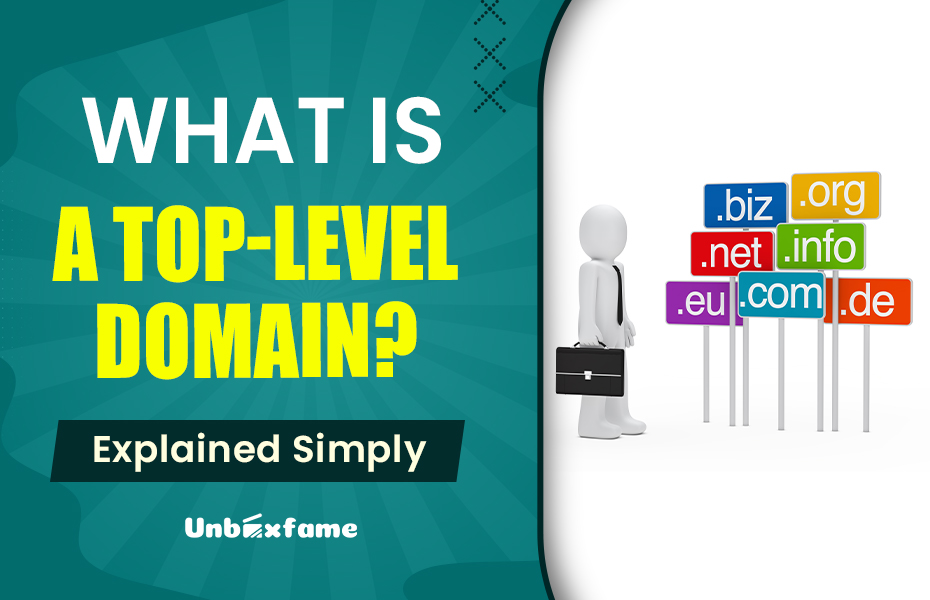
There was a top-level domain lying on your neck as you were visiting something on the web. It is either .com, .org, .in, or .edu; it is a very significant part of the internet functionality at the end of a web address.
A top-level domain (TLD) refers to the last part of any domain name
Examples:
For instance:
– If we take the example of the case of Google.com, the TLD is .com
– As a rule of thumb,
– When describing a TLD, it’s about the second and third levels.
The highest domain of wikipedia.org is .org.
- In bbc.co.uk, the TLD is .uk
TLDs function as the highest level of the Domain Name System (DNS) hierarchy because they have no levels that exist beneath the root. The home address serves as a domain name example. A TLD functions as a web address categorisation that identifies either a specific country or a general category.
Why Are TLDs Important?
TLDs serve two main purposes:
They help in the organisation of the Internet
There are billions of websites on the Internet. TLDs are helpful in the classification and categorisation of them. For example:
- .com – Commercial businesses
- Government organisations.
- .edu – Learning institutions.
- Queer.org non-profit organisations.
This kind of categorisation enables this to be the case in that one is able to know what a site entails just by looking at it.
They are engaged in DNS lookups
When you enter the URL of a website into your web browser, it is your PC’s job to locate the correct IP address of the server hosting the website whose address you have entered.
This is what occurs;
- We make sure to enter a domain name, e.g., xyzwe.com.
- A DNS resolver is contacted by your browser.
- The resolver authenticates the TLD server (.com).
- It is directed to the right authoritative server by the TLD server.
- The IP address will be given by the authoritative server.
Your browser would be lost without TLD servers. This is why TLDs are necessary in the operations of the internet.
Who Controls TLDs?
The best of the management in the world’s top-level domains (TLDs) is handled by an organisation known as ICANN (Internet Corporation for Assigned Names and Numbers).
ICANN will not directly sell domain names. Rather, it makes available the operation of various TLDs to certain organisations.
For example:
- VeriSign manages .com and .net
- TLDs such as ‘.in’ or ‘.uk’ are handled by national organisations.
The domain registrars (such as GoDaddy, Namecheap, or Cloudflare Registrar) then enable one to rent domain names over these TLDs.
Various kinds of Top-Level Domains
The TLD is not of a single kind. They can be categorised under several classes:
Generic TLDs (gTLDs)
These are the TLDs that are the most widespread and prevalent.
Examples:
* .com
* .net
* .org
* .info
* .biz
Initially, generic TLDs were few. In 2010, however, the system was expanded by ICANN. Currently, hundreds of newer alternatives exist, such as:
* .xyz
* .online
* .store
* .tech
* .app
These provide greater benefit in branding businesses.
Country-Code TLDs (ccTLDs)
These are domain extensions of two letters, which are provided to nations or territories.
Examples:
- .in (India)
- .uk (United Kingdom)
- .au (Australia)
- .jp (Japan)
The use of country-code domains is best suited when a business has a focus on a given region.
Sponsored TLDs (sTLDs)
These are professional fields that are handled by a certain community or organisation.
Examples:
- .gov (U.S. Government)
- .education (Learning institutions)
- .app (Application developers)
These tend to bear conditions of eligibility.
Infrastructure TLD
It has only a single infrastructure TLD:
- .arpa
It is technically in use, including reverse DNS queries, and would not be used in normal websites.
Reserved TLDs
There are also permanently reserved TLDs, for which no public registration is possible.
Examples:
*localhost
*example
*test
These are applied to testing and documentation.
Do TLDs Affect SEO?
This is a common question.
The brief reply: The TLD is not directly needed to influence search rankings.
However:
Local SEO can be achieved with country-code TLDs (such as .in or .uk).
* TLDs with a good reputation, such as .com, can lead to a better level of trust and number of clicks.
* The presence of a relevant TLD (such as e-commerce, such as .store) may increase the clarity of branding.
This is why, although TLDs do not have a direct impact on rankings, they do have an effect on user perception and branding, which, in turn, affects performance indirectly.
Should You Always Choose .com?
.com was regarded as the gold standard for several years. It remains the most well-known and reputable field extension in the world.
Nevertheless, nowadays things have become different.
Other options available to you:
- .co
- .io
- .tech
- .online
can also be used in a very effective way, that is, when they have a compliment to your brand identity.
The point is memorability and being understood.
Registration of a TLD Domain: How to register a domain with a TLD.
Registering a domain is not complicated:
- Choose a domain registrar.
- Search for your desired name.
- Select an available TLD.
- Pay the registration fee.
- Register every year to retain ownership.
Noteworthy: You do not own a domain permanently. You lease it. If not renewed, other persons can have it registered.
How Much Do TLDs Cost?
Pricing depends on:
* Popularity
* Demand
* Type of TLD
* Registrar pricing
For example:
.com domains tend to be of moderate annual charges.
Certain TLDs, such as ‘.ai’ or ‘.app’, can be more expensive.
Promotional pricing can be offered in the first year.
There is a need to always watch renewal rates before buying.
Final Thoughts
It may seem that a top-level domain is a minor thing embedded at the end of a web address, but it contributes immensely to the structuring, protection, and navigation over the internet.
To recap:
- The final component of a domain name is known as the TLD.
- It helps classify websites.
- It is vital to DNS lookups.
These are of various forms, namely, generic, country-code, sponsored, and reserved.
Branding and user confidence are influenced by a proper choice of TLD.
No matter if you are about to start a blog, start up a business, or develop an international brand, the choice of the appropriate TLD is just one of the steps towards creating an online identity.
The internet can be so complicated, but having some knowledge of simple items such as TLDs will provide you with more power over your online existence.