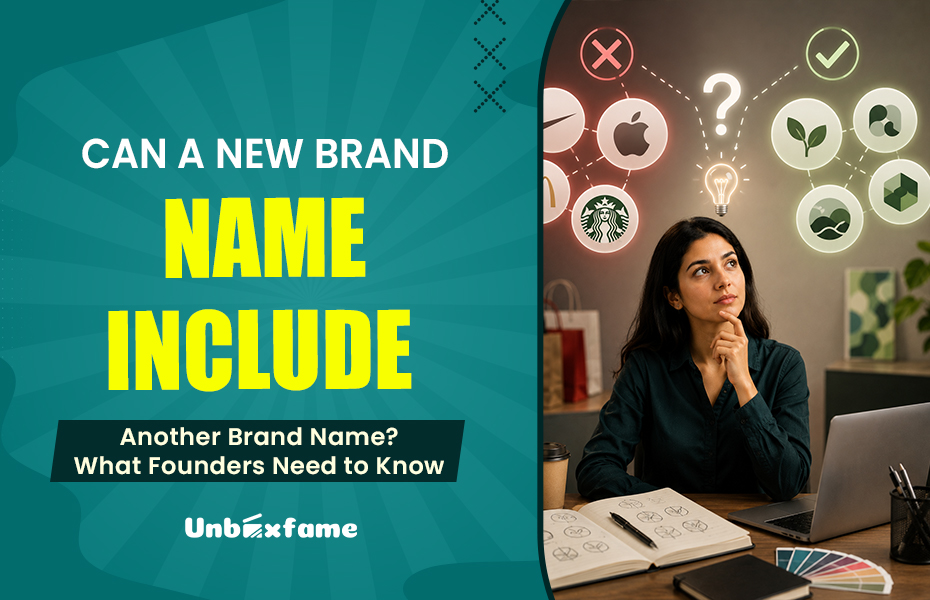
You’ve finally decided on the name. It clicked. You heard it aloud a couple of times, and it simply sounded good. Then, just about instantaneously, the question comes to mind: but doesn’t there already exist a brand that has something similar?
Here’s the thing. That concern is much more prevalent than people acknowledge. Most founders don’t seek out a lawyer until after the logo is created, the URL has been purchased, and the Instagram name is registered. So let’s get to the point, in a non-technical manner, before we get too deep.
Is It Legal to Use Another Brand’s Name in Yours?
Technically, yes. A name is available that contains one of the names of an existing brand. No one will prevent you from putting it in a design brief.
In a legal sense, that’s another matter. There is a lot of “technically” in that sentence. It is not a matter of whether you actually plagiarized a word intentionally. It’s whether a regular customer who was not paying close attention saw your name and assumed it was related to another brand. That’s it. That is the essence of the entire test, and attorneys refer to it as “likelihood of confusion.” The remainder of this article is all this one idea, dressed up in various guises.
“I’ll Just Add a Word” Won’t Save Your Trademark
This is likely the most frequent solution people will attempt to use, and in most cases, it never goes as the founders would expect.
The mere addition of “Hub,” “Store,” “World,” or other generic terms to the name of an already established name does not automatically make it a new brand in the eyes of the law. A court does not count additional letters. They consider the dominant part of the name, which is essentially whatever comes to mind for a customer. Would people still envision the original brand if you removed your added word? If so, you have a problem,m and the added word is unlikely to bring you peace in conflict.
Do the same test with someone else. Tell someone who doesn’t know the names of either brand the name of your shortlist, and then listen to what comes to their mind. It’s a hard test, but it’s a better one than looking at the spelling.
Trademark Similarity Explained: When Two Names Cross the Line
Two names may sound totally different when written on paper and yet be a problem. That is the aspect that people underestimate.
There are several angles on which this is judged:
- Does it sound the same out loud? (Phonetic similarity)
- Is it the same when written? (Visual similarity)
- Does it sound the same in your head as other words? (Conceptual similarity)
Changing a vowel or dropping a letter is not the solution people believe it to be. In reality, no one is comparing spellings side by side. Because customers are dealing with half-attention, half-memory, and half-bells, that’s what trademark law is attempting to cover.
“We’re in a Different Industry” Isn’t the Legal Safety Net You Think
This is a frequent question asked and not entirely right. It’s not the complete shield as people believe.
Other categories of products reduce the risk. Indian courts, however, have done a lot to look beyond the hard distinctions and have considered several factors when determining what constitutes a party, such as the proximity of the two businesses, who actually uses the product, and whether consumers would reasonably expect a relationship between the two brands. That’s where another category comes in handy. But it doesn’t promise that anything will occur.
Got the Domain? Here’s Why That Doesn’t Mean You’re in the Clear
Nope. This is a common mistake of founders.
The worlds of domain name registration and trademark rights are totally different. Neither can a domain seller tell you if the name you just purchased is legally owned, nor does it matter to them. The .com is only one little checkbox to check; it is not the finish line.
MCA Approved Your Company Name? That’s Not Trademark Clearance
This is possibly the biggest mistake that most Indian founders make, and it is easy to fall into.
Just because the MCA or ROC has approved the name of your company does not mean that no other company has already used exactly that name in that particular database. It says nothing about the Trade Marks Registry, and it won’t provide you with any protection if there is a later trademark objection. Many entrepreneurs have learned this lesson the hard way, typically after they’ve invested in packaging and marketing.
Thinking of Echoing a Famous Brand Name? Read This First
The more popular the brand, the more it is protected by the law, and this is a surprise.
If your product is not related to theirs, they can start claims for brand dilution or unfair association with their product just because you use a popular name. Larger companies will also tend to have more stringent enforcement of their rights, primarily due to the fact that they can afford to. If your dream name rhymes with a large object, then that’s a bad sign; don’t dismiss it as a coincidence.
The Real Checklist for Brand Name Availability (Beyond a Google Search)
A real check isn’t merely a Google search of the name, followed by hoping for nothing bad to show up on the first page.
It should include a good search in the IP India portal (not only names that sound similar, but also the ones that haven’t been registered at all), verifying the availability of the domain name and social media handles, and an overall name search to see if any names are already in circulation but not registered. Don’t miss any one, and you are leaving a hole.
Bottom Line: Get Your Name Right Before You Build a Brand Around It
Naming a business is a lot of fun until the legal aspect comes up. By this time, I’m sure many founders have sunk some real dollars into a name that was never a sure thing to pick out of that.
It is easier to prevent a problem than to solve a problem afterward. If you’re unsure if your short list is secure, have it verified prior to making any final decisions, such as printing business cards.